Will AI Replace Architects? The CAD Monkey Era Is Over
What a conversation between Mark R. LePage and Chad D. Reineke on the EntreArchitect Podcast says about AI, judgment, and the real value of this profession.
Last week, episode EA669 of the EntreArchitect Podcast put words to something many of us in this industry have been feeling but struggling to articulate. Host Mark R. LePage sat down with Chad D. Reineke — architect, educator, COO of Lightroom Studios, senior project architect in NELSON Worldwide's hospitality practice, and author of the new book Rules of Practice: The Ethics of Making Architecture.
Somewhere in the middle of the conversation, Chad said the thing I haven't stopped thinking about since:
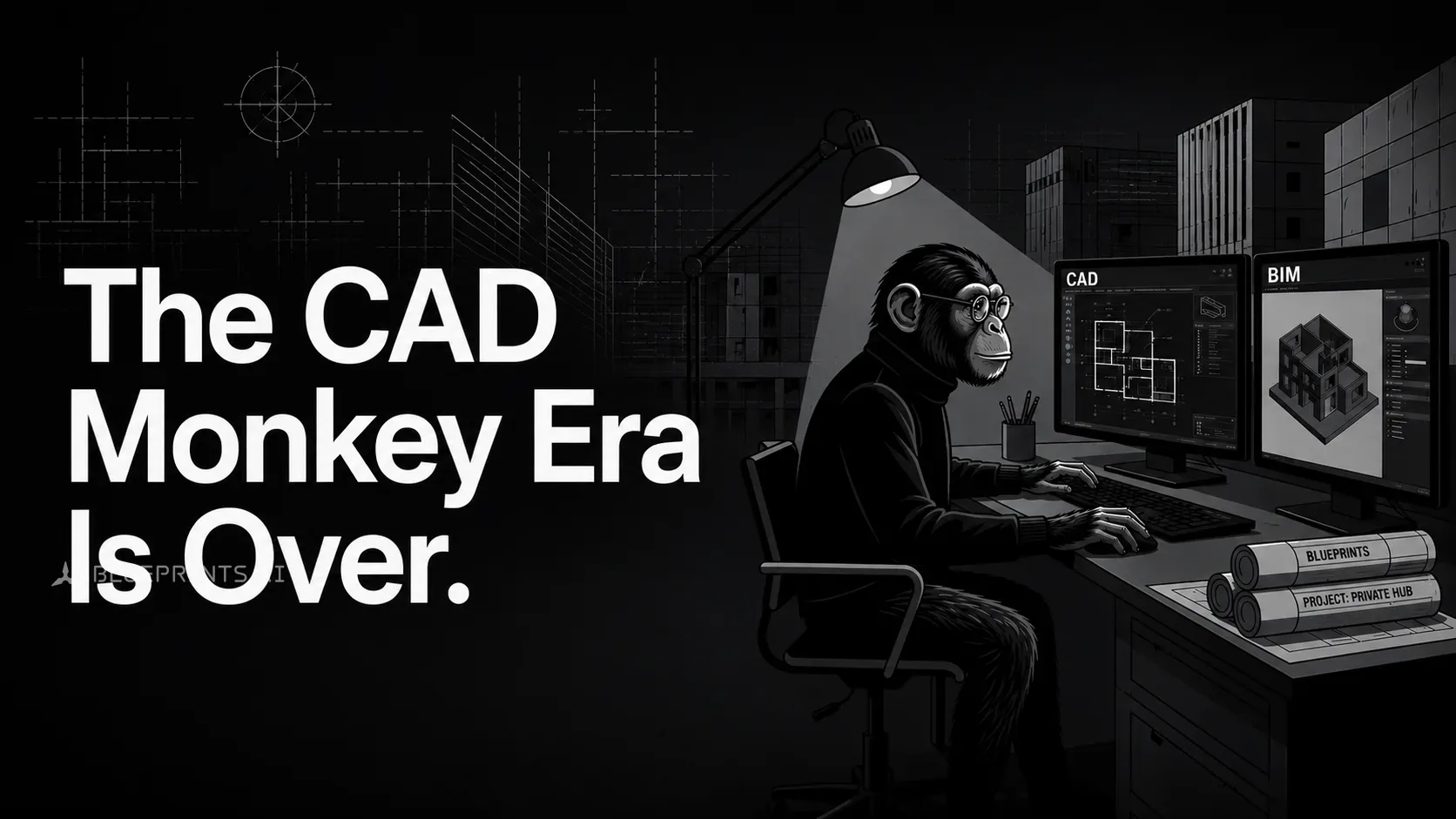
We're not CAD monkeys. … That's how the bill gets paid — we're Dunder Mifflin, we sell paper. We just so happen to put instructions on the sheet of paper. We have a great ability right now to re-adjust that back to judgment being our value as architects.
He earned the right to use the term. Chad came up through drafting and carpentry, spent years as a BIM manager at multiple firms, and now works at both ends of the food chain — drafting alongside his staff at Lightroom in the morning, reviewing and redlining at NELSON in the afternoon. When someone with that résumé says production was never the point, it's worth listening.
How a profession became a production line
For decades, the software arms race quietly redefined what architects sell. First CAD, then Revit, and firm after firm learned to compete on the same pitch: we can produce faster than the firm down the street, with fewer RFIs. As Chad put it, “we got lost in the idea of how fast you can produce drawings.”
Mark named the trap in a single sentence: it's easier to sell deliverables than it is to sell judgment. And Chad's answer is the line every architect should pin above their desk:
Deliverables last for a year, two years. Your judgment and the decisions you made in your buildings last much longer.
That's how a generation of talented, licensed problem-solvers ended up with careers measured in sheets per week — CAD monkeys and BIM jockeys, with the title of “manager” attached to the software instead of the architecture.
What clients are actually buying
Chad's definition of the job is the best I've heard in a long time: clients hire architects to prevent problems.
His examples are deliberately unglamorous. On industrial projects, he would open every job with a parking variance — design the site for the full sea of parking the code imagines, but pave only a third of it, hold the rest as a field, and cut the stormwater burden until the day the client actually needs more spaces. Or the small move of putting a slant on an overhead ledge, so dust rolls off — a decision made not for the rendering, but for the cleaning staff who will live with the building for thirty years.
That's architecture. The final use of the people occupying the building, how they function in it, and the future need beyond it. That's the judgment we're hired to make — because clients don't have that.
None of that shows up in a deliverables list. All of it is why the building works a decade later.
What AI actually changes
Here's where the conversation gets interesting for anyone watching AI move into our industry.
Chad expects AI to finish what Revit started: the original promise that a competent, experienced architect could deliver an entire project themselves. In his ten-year picture, you bring a sketch, and the “rough grunt drafting” is greatly diminished — while a human still checks, still interprets, and still carries the responsibility.
But he's just as clear about what AI will not do. His former studio classmate Patrick Chopson built one of the most advanced AI design engines in the industry at cove.tool — and, by Chad's telling, would be the first to admit that left alone it will design “the ugliest building in the world.” Fully code-compliant. Roughly on program. Hideous. Because AI calculates; it doesn't judge. It doesn't understand nuance, site, or the person who has to clean the ledge.
Two more predictions from the episode deserve your attention.
First, the competitive shake-up: small firms that embrace AI for production will start landing the kind of work that historically went to Gensler, HKS, and HOK. The production moat around the giants is draining.
Second — my favorite argument of the entire episode — the schedule:
Let's not shorten the schedule. Let's keep the same schedule, and use AI to produce better projects in that same schedule.
The market will push every hour AI saves toward faster and cheaper. Architects should push those hours toward better — more thought, more coordination, more judgment per project. That is a choice, and it has to be made deliberately, firm by firm, fee proposal by fee proposal.
The real risk was never replacement
“AI is not going to replace architects,” Chad says plainly. The real risk is subtler: that we keep defining ourselves by the production layer while that layer evaporates underneath us.
The profession got a preview of the open questions, too. If entry-level careers no longer begin with a stack of redlined drawings — Chad's own education, handed to him a stack at a time until, as his project architect put it, “you'll eventually start to figure out what I'm going to redline before I redline it” — then how do we train the next generation to develop judgment at all? Nobody has a complete answer yet. Chad joked it might take a third book.
What isn't in question is the posture. As Mark put it: we have to embrace it and be the leaders of it, or somebody else will. Chad's addition should make every architect sit up straight: “and I can tell you the contractors are not far behind.”
Be an architect again
So here is the takeaway, for architects, in plain terms.
Let AI have the low-level work. It was never your value — it was just how the bill got paid. While the machines take over production, get better at the things you were actually trained for: judgment, decision-making, seeing the problem behind the client's request, designing for everyone who will ever touch the building. Sell that. Price that. Say it out loud in your next proposal: you are not paying me for drawings; you are paying me to prevent problems.
The architects who thrive in the next decade won't be the fastest CAD monkeys or the most certified BIM jockeys. Automation ends that race. They'll be the ones who used the hours AI gave back to become unmistakably, irreplaceably architects.
Full disclosure: this is exactly the future we're building toward at Blueprints AI — AI that turns your design into code-compliant construction documents, so the 60–70% of professional hours lost to documentation grunt work can go back where they belong: your judgment. But you don't need our product to act on this episode. Listen to it. Buy Chad's book. And the next time a client asks what they're paying for, don't say drawings.
Listen, read, follow
The episode: EA669 – Rules of Practice: The Future of Architecture and Ethics · Apple Podcasts
The book: Rules of Practice: The Ethics of Making Architecture (Kindle edition) — his next book, The Reflective Architect, arrives via Routledge in November
Chad D. Reineke: LinkedIn · Lightroom Studios · NELSON Worldwide
Mark R. LePage: LinkedIn
Quotes lightly edited for readability from the episode audio.