The First Software I Ever Touched Was AutoCAD R10. Now 5,000 People a Month Use Ours.
At four, in Tehran, my uncle let me roll the trackball on his laptop and draw a circle in AutoCAD Release 10. Today CAD Editor, our free browser CAD, passed 5,000 people in 30 days. That afternoon, footnoted, with the receipts and a respectful note to Autodesk.
Free 2D CAD in the browser
First software: AutoCAD R10
~14 min
9,134 SINCE JUNE 29
100+ COUNTRIES
On November 8, 2026, CAD Editor, the free browser CAD tool built by Blueprints AI, passed 5,000 people in a rolling 30-day window: 5,027 of them, up from 2,418 in the 30 days before.[1] This paper does four things. It documents the first software its author ever touched: AutoCAD Release 10, on an uncle's laptop in Tehran, for about twenty minutes before lunch. It follows what those twenty minutes started, a habit of learning software by clicking it. It explains why a company that generates construction documents with AI gave away a 2D CAD editor. And it pays its respects to Autodesk, in Autodesk's own numbers. Every claim is numbered and cited below; where no published source exists, we show the arithmetic.
1. Twenty Minutes Before Lunch (Where This Starts)
I was four, maybe five: old enough to remember, too young for school. It was a family gathering in Tehran, the kind with too many cousins and a lunch that takes all afternoon to arrive.
The family explains a lot. My father met my mother at the University of Tehran. She was one of four sisters, and my father and two of his classmates married three of them, all on the same day, at the same party.[2] So I grew up with four architects at every family table: my mother, my father, and the two uncles who had been my father's classmates first. My brother, six years older, later became the fifth. Two of my aunts became professors. The footnotes run in the family.
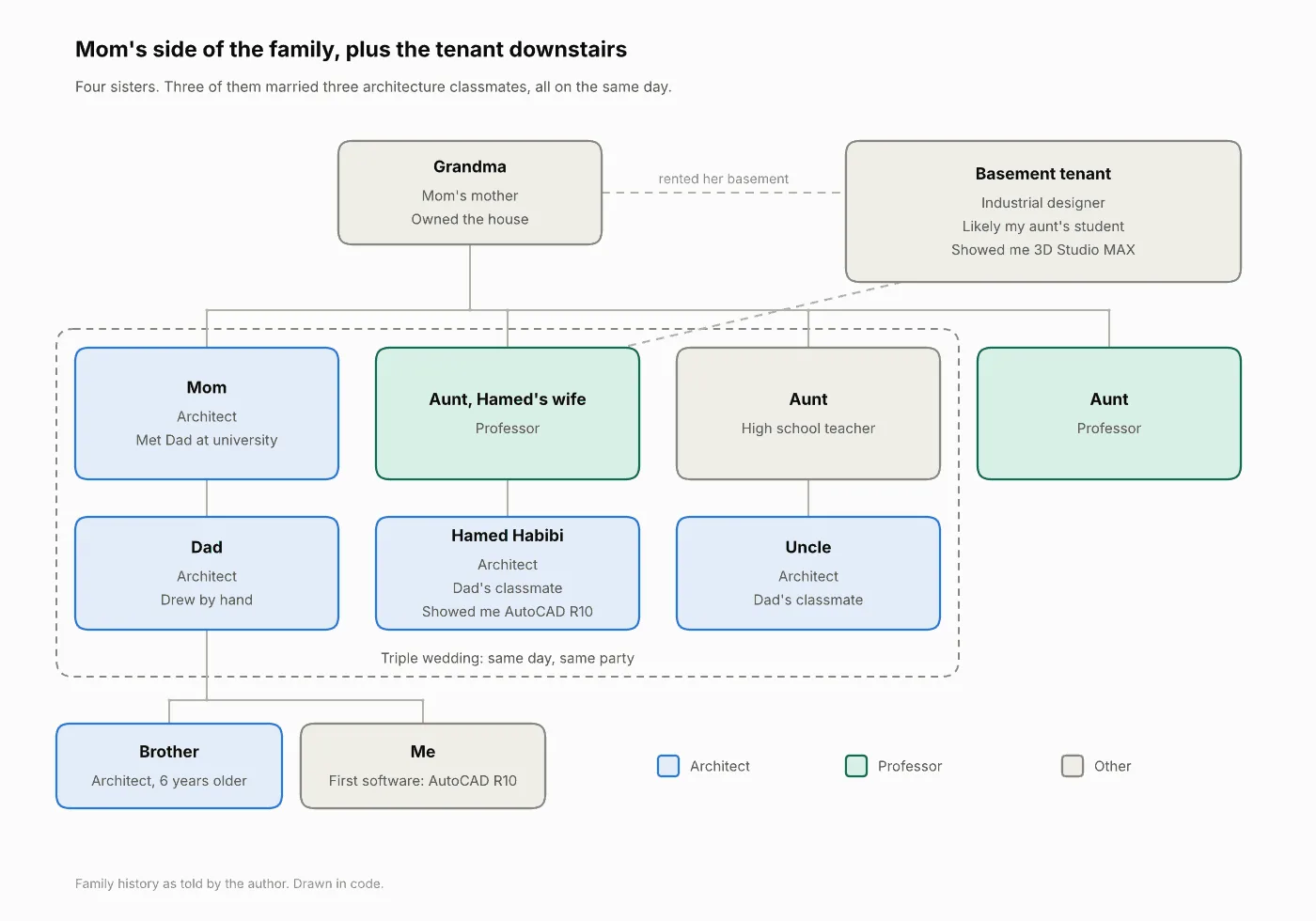
One of those uncles, Hamed Habibi, was the nicest person in the family to me. He said he saw something in me that no one else could see. In our family, that sentence is famous.
Hamed was also the nerd among the architects. My father, who drew everything by hand, used to tease him about all the hours he spent on computers. Hamed did not mind. He clearly had the most fun, and the whole family saw him as the one from the future. That was a big title at a time when nobody else in the family knew computers, and a color TV, then a Commodore 64, counted as high technology.[3]
That afternoon he took me to their bedroom, away from the noise of the family. He did not want to attract too much attention; he just wanted to show me something cool. White walls: my family were architects raised on the Bauhaus and modernism, and their homes showed it. We sat on the bed. Across from us stood a black makeup desk, piano finish, with a rectangular, black-edged mirror leaning on it.
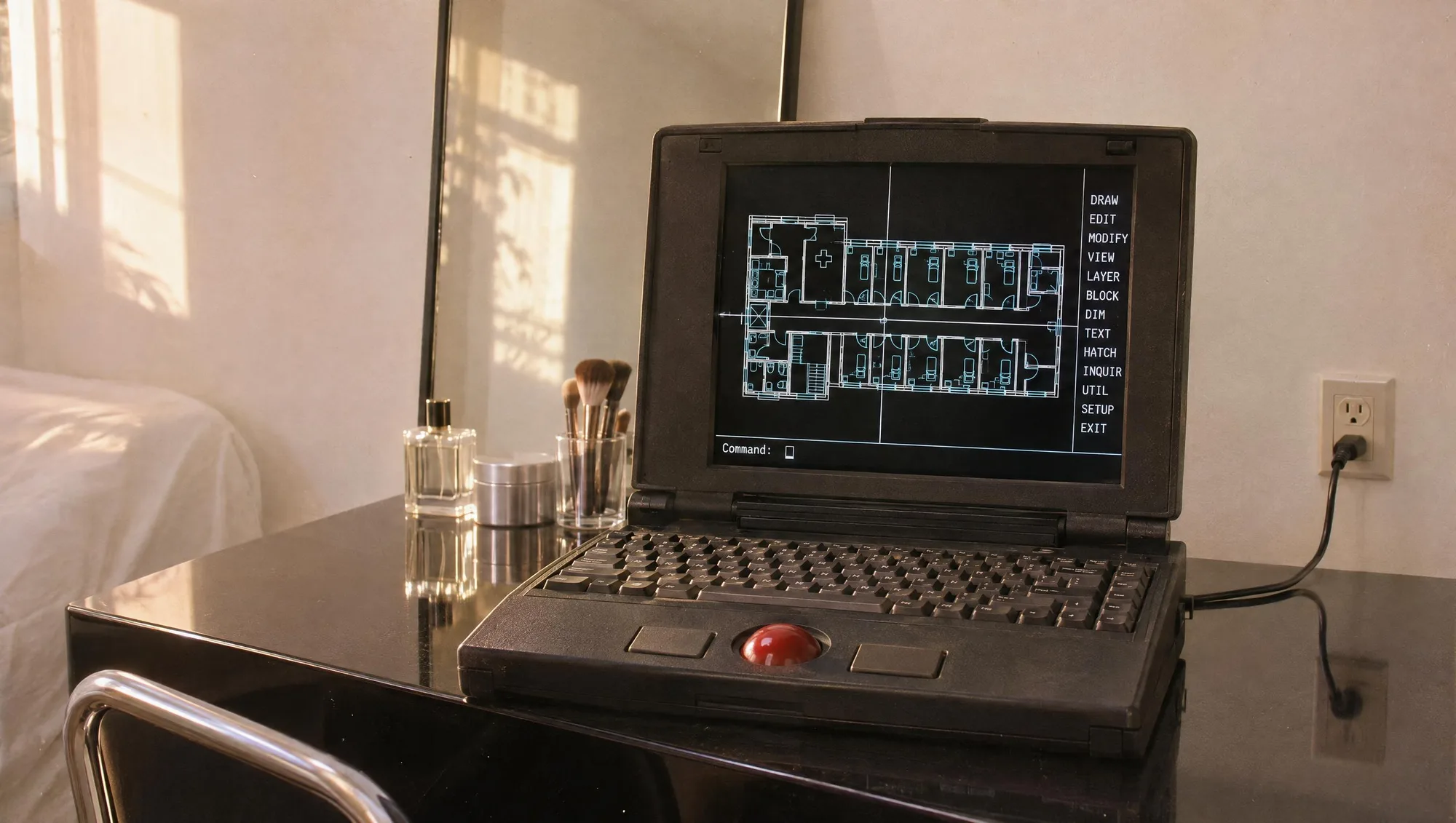
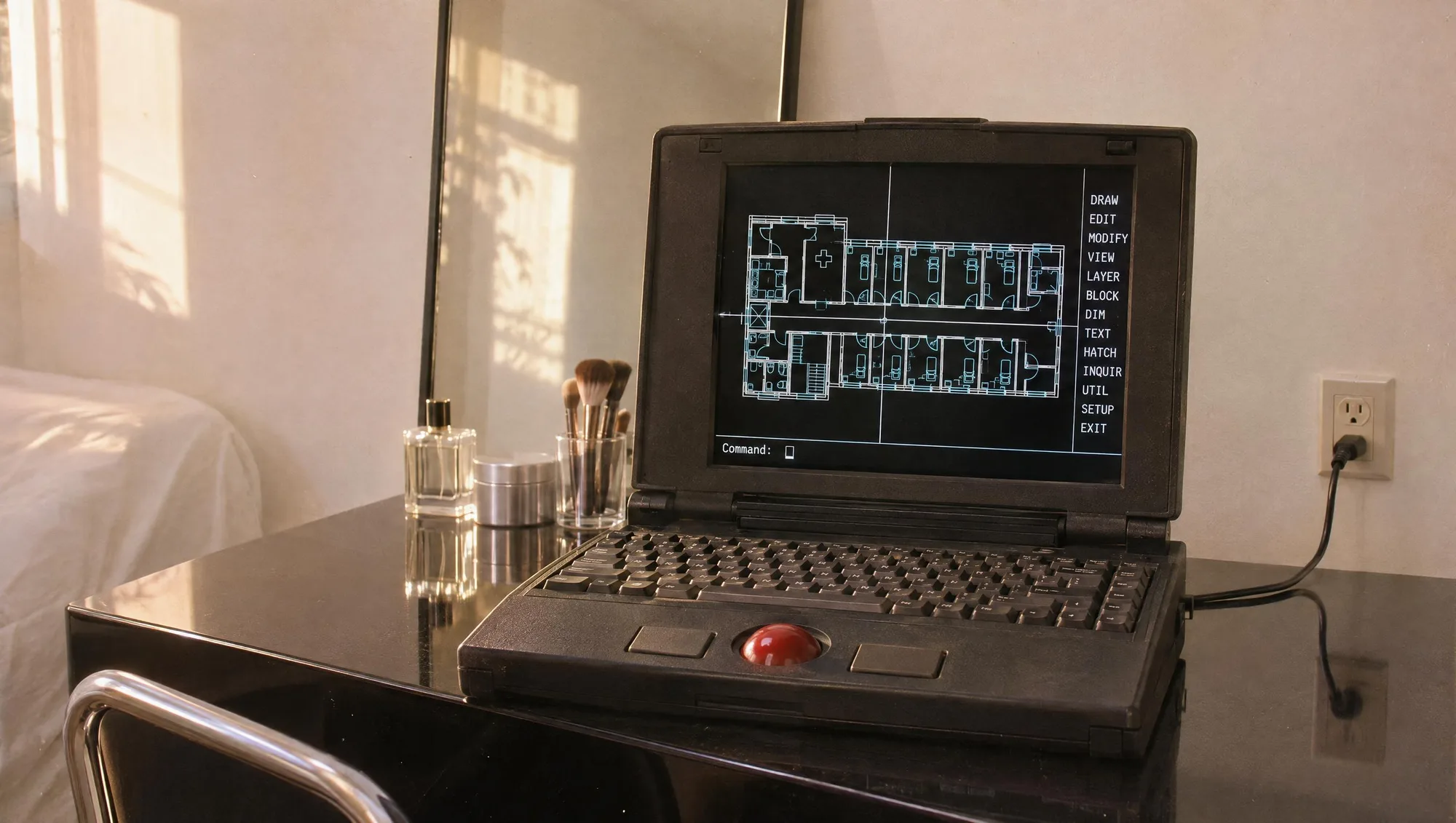
Then the laptop. A Compaq, black and thick, with a small, nearly square screen, plugged into the wall (whether the battery worked, I never found out). Where a mouse should have been, there was a ball: big, shiny and smooth. In my memory it is red. It may have been black. Memory paints the important things red.[4]
He turned it on. White letters on black, a blinking cursor, and C:\>. No Windows.
DOS (Disk Operating System) is what most PCs ran before Windows took over: a black screen, a blinking cursor and a prompt, usually C:\>. No windows, no icons, no mouse pointer. You typed the name of a program and pressed Enter. Windows 3.1 had been out since April 1992, but AutoCAD Release 10 was a DOS program, so you met it the DOS way: by typing.[5]
AutoCAD came up: a black drawing area, a column of words down the right side, a command line at the bottom, and a crosshair in the middle.[6] To me it was all text, except the crosshair. First he showed me his work, plans for a hospital his office was designing. Flat, 2D, more lines than one small person could hold.
Then he let me roll the ball, and the crosshair moved. He told me what to type, and I drew a line. Then another. Then a circle. I played for about twenty minutes, until someone called us to lunch.
I remember the feeling better than the drawing. It felt like power: power I could control but had not created, as if the thing had been made by gods. It did not occur to me that people had made it. Nobody else at the party cared. It stayed with me until we got our first computer.
Back home we had the Commodore 64 and a little gray console we called the Micro, as in "let's play Micro." The name most likely came from Micro Genius, the Taiwanese Famicom clone that reached Iran in 1992.[7] Those were for playing. Hamed's laptop was for making buildings.

2. What I Was Looking At (AutoCAD R10, Footnoted)
Since this is the kind of article that has footnotes: AutoCAD was first shown at COMDEX in 1982 and shipped that December.[8] Release 10 shipped in October 1988. It could already do 3D, with multiple viewports and user coordinate systems,[9] and Autodesk's founder, John Walker, praised the team for managing to "squeeze a full 3D CAD system with surfaces into the same 640K" of memory as the release before it.[10] What I saw that day was flat: plans. The browser tab you are reading this in is using a great deal more than 640K.
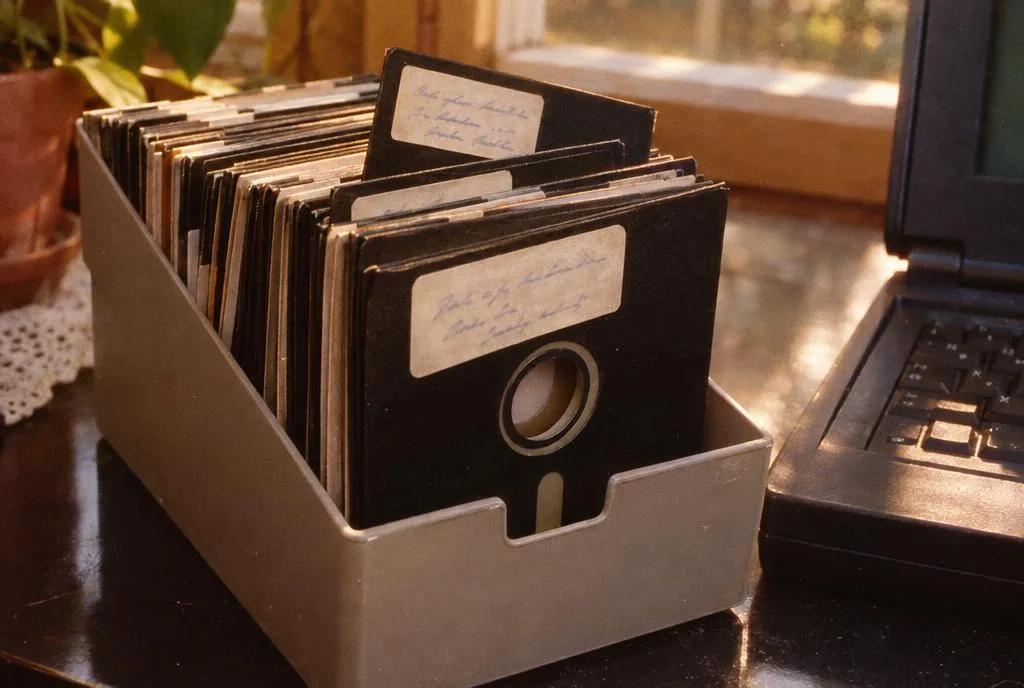
Then there were the floppies. Hamed kept an archive of big ones, 5.25-inch disks that held 360 KB to 1.2 MB each.[11] I am not sure they belonged to that laptop. I am sure they held years of his drawings, in boxes. Remember those boxes; they come back in section 5.
3. My Father Drew by Hand
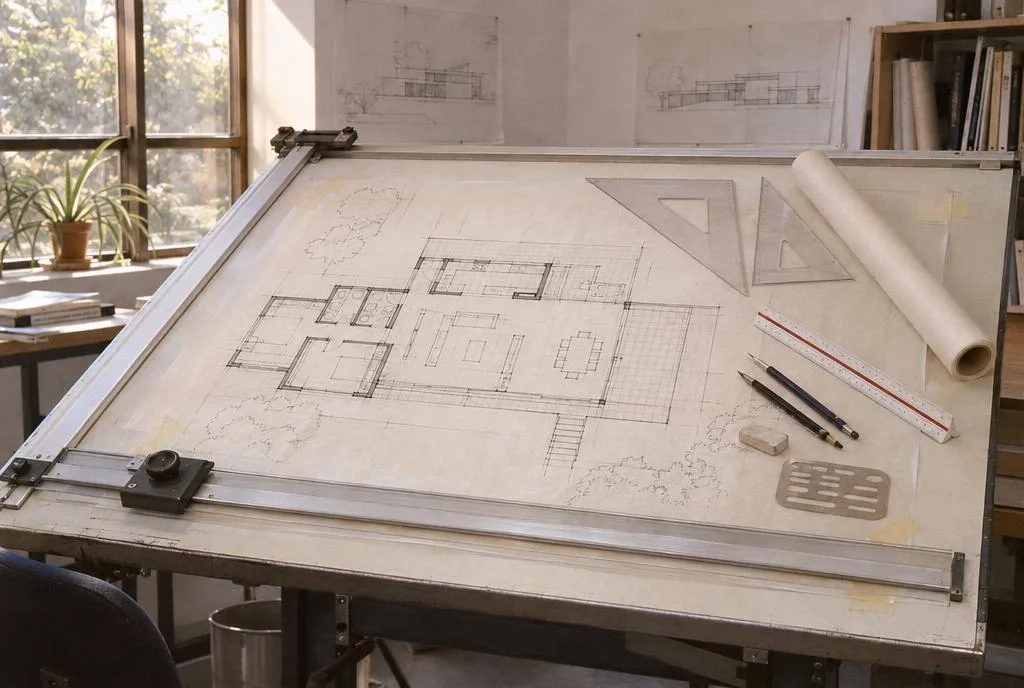
My father drew by hand, and kept drawing by hand until he passed away three years ago. At our family's firm, drafters turned his drawings into CAD and 3D. My uncle drew with a crosshair. Two architects from the same class, two ways of putting a building on paper, and I got to see both before I started school.
4. How I Learned the Word "Bend" (3D Studio MAX, Release 1.1)
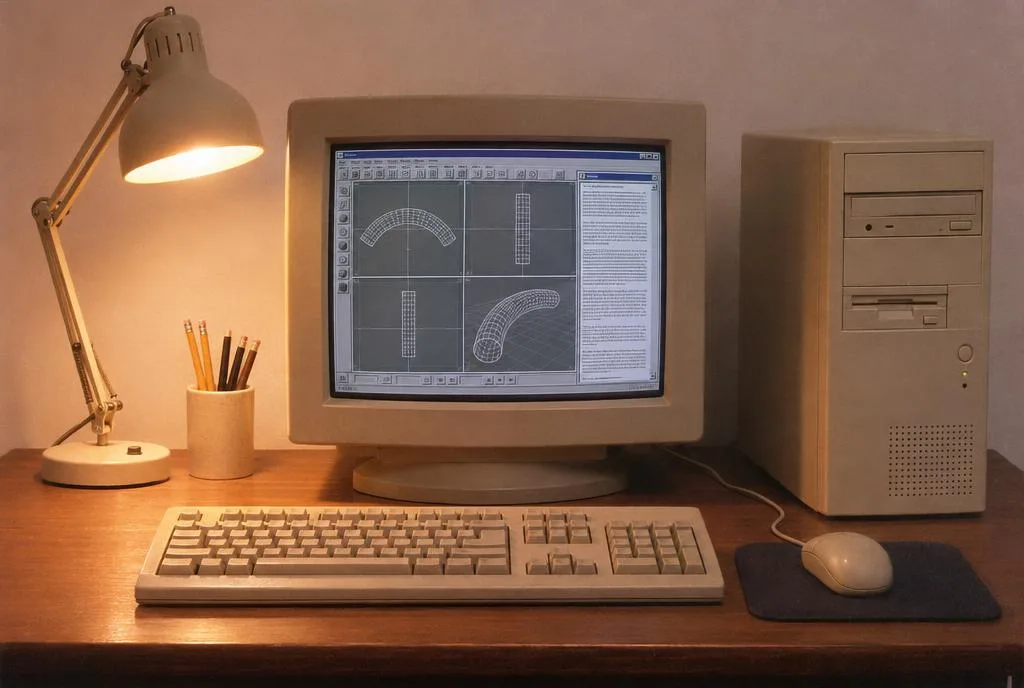
My second computer moment happened in my grandmother's basement. My mother's mother rented the unit downstairs to an industrial designer, probably a student of one of my aunts. He had a three-foot model car that could expand, beautifully designed and airbrushed. One day he showed me 3D Studio MAX, I think the very first release, and let me play. It was the laptop feeling all over again. Soon I had my own copy of Release 1.1.[12] Autodesk again, more or less: the Yost Group wrote it, Autodesk's Kinetix division sold it, and Autodesk later bought it outright.

There was no YouTube; it would not exist for another nine years.[13] There was no teacher. There was the program's own help section: mostly text, a few images. Nobody makes help like that anymore. I did not know the English word "bend," so I clicked Bend, dragged a number, and watched a cylinder curve. That is how I learned the word.
That became the method for everything since. AutoCAD, SketchUp, Revit, Python, software engineering, setting up a company, selling, supporting customers: no classes, nobody assigned to teach me. Click, try, break it, try again.
(Note to self: telling people they can learn anything by clicking is how you get more competitors. Publishing anyway.)
If Hamed had not shown me that laptop, I would have found computers eventually, but late, maybe too late. He kept calling me smart. "Very smart." In a family where nobody knew computers, that was enough to send a kid into a help file and keep him there. I am where I am because of those twenty minutes and those two words.
5. Why an AI Company Built a Free CAD Editor
Blueprints AI generates construction documents with AI. So why build a 2D CAD editor, and then give it away?
Because we needed it ourselves. Our own software has to import drawings, export them and show them, so we built an editor to do exactly that, as an internal tool. Now we are giving it away. It also keeps the drafting inside our system. Clients still want CAD and Revit files at the end, which is fair, but the moment a drawing leaves, the AI loses the thread: why a line moved, what changed first, what changed because of it.[14]
Then there is the bill. Firms we talk to pay for 40 seats[15] of AutoCAD LT, AutoCAD or the AEC Collection. At this month's US list prices, that is $21,600, $83,800 or $147,000 a year, and the last one comes to $441,000 over a three-year term, before anyone draws a line.[16] Then comes the time: installs, license checks, machines strong enough to run it all, hours of learning. And CAD is not going anywhere. Engineers, especially in civil and landscape work, still do most of their drawing in it.
That bill is the strange part. A CAD tool still needs your hours, so why should it need your money too? It is static software: nothing happens until you sit down and draw. AI is different. It does the work, and it costs us real money every time it runs, so that is what we charge for. The editor is free.
Remember Hamed's boxes of floppies? Every firm has its own version: years of details and drawings. CAD Editor opens them. It edits and exports DXF and opens DWG,[17] so a firm can bring its archive along on day one. Getting in costs nothing, and the savings start immediately.
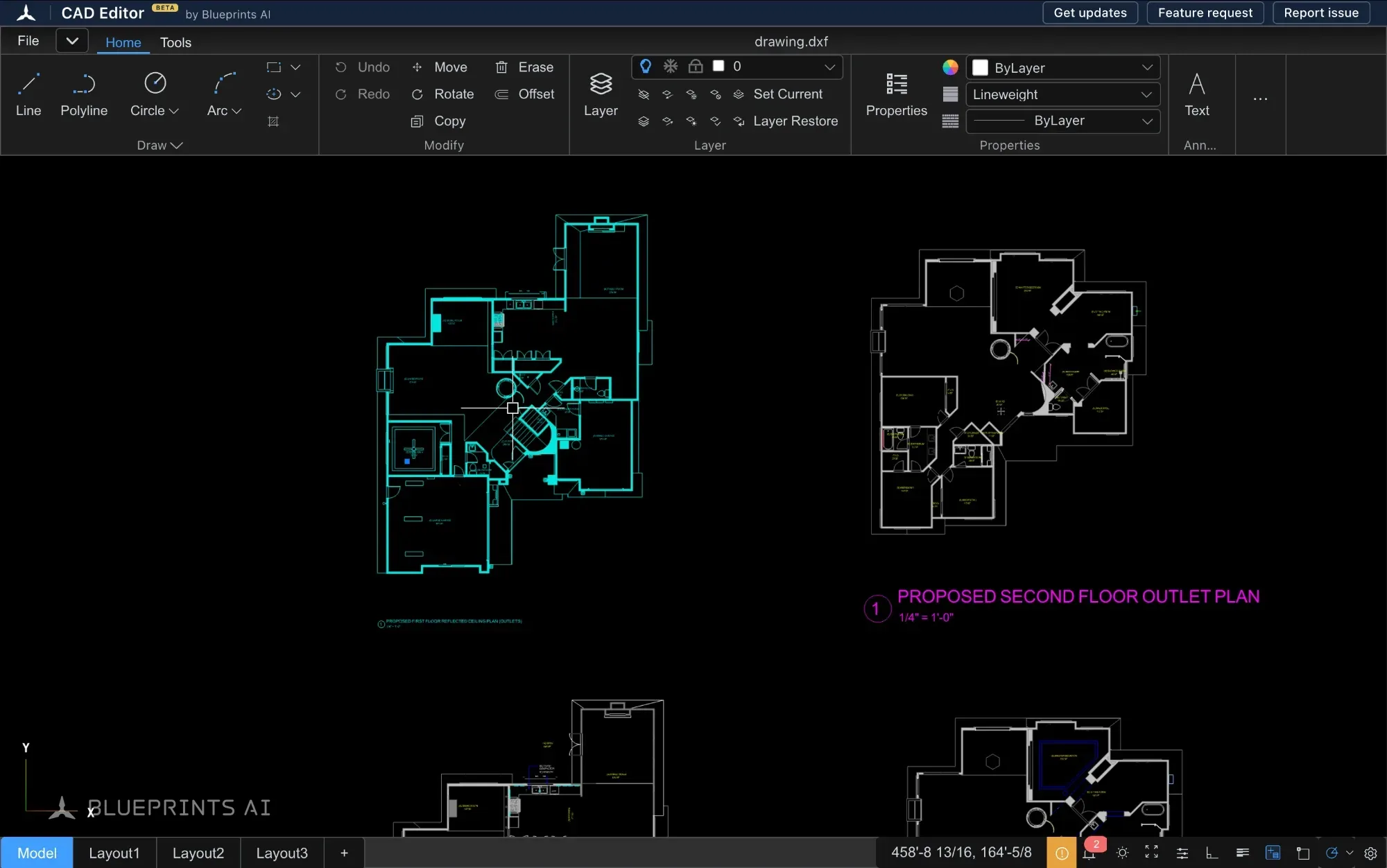
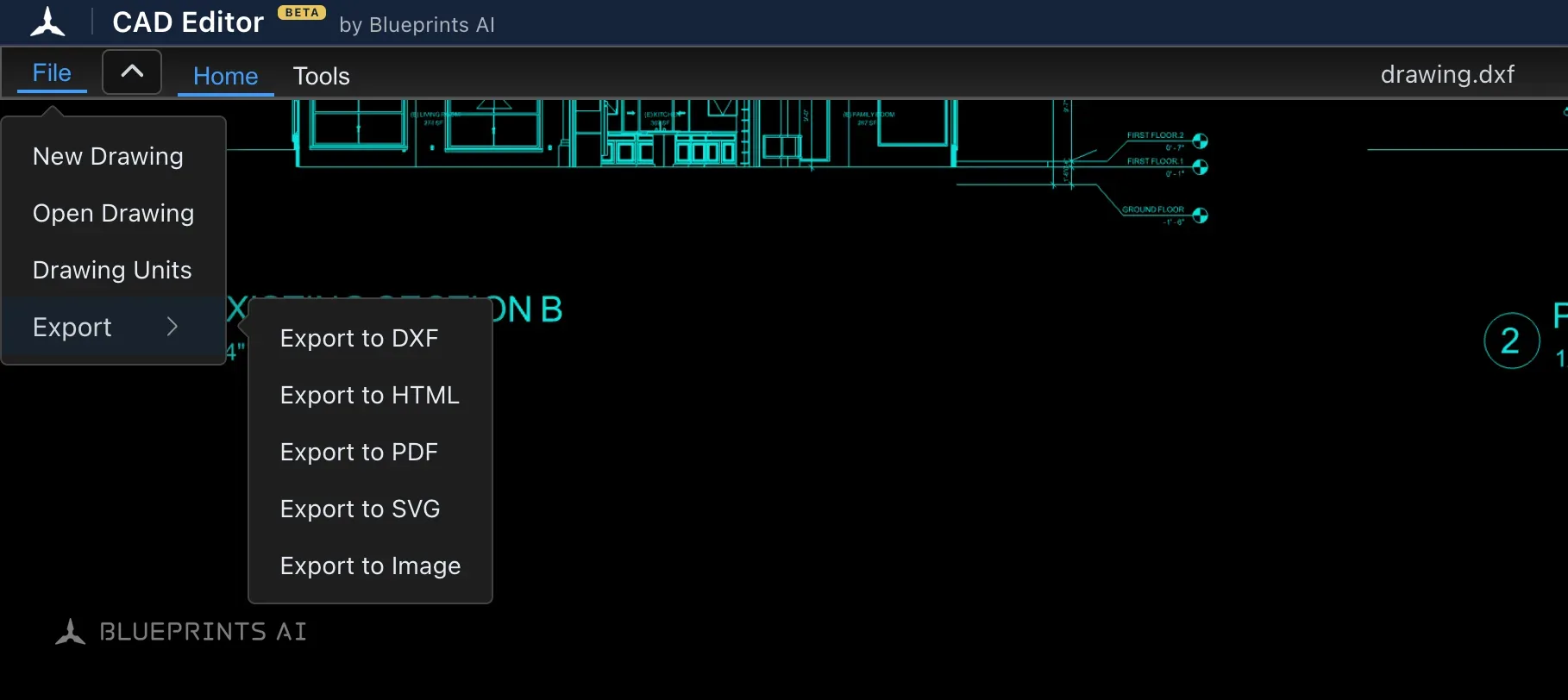
We put it online free this summer, about three months before AI-built, open-source copies of Adobe and Autodesk apps, PhotoCraft and CADCraft among them, arrived in October.[17] It runs in any modern browser, on a laptop, a tablet or a phone, with layers and snaps that behave the way drafters expect, and it knows that 5 space 5 means five feet, five inches. No install, no account, no license check.
It is still CAD, so it still takes learning. That is why the people who already know AutoCAD are our best users: they keep their speed. Same commands, same keyboard habits, type a command and hit Space, plus a few changes for comfort. Typing C and Enter starts Copy, not Circle.[17]
6. The Numbers (Receipts Included)
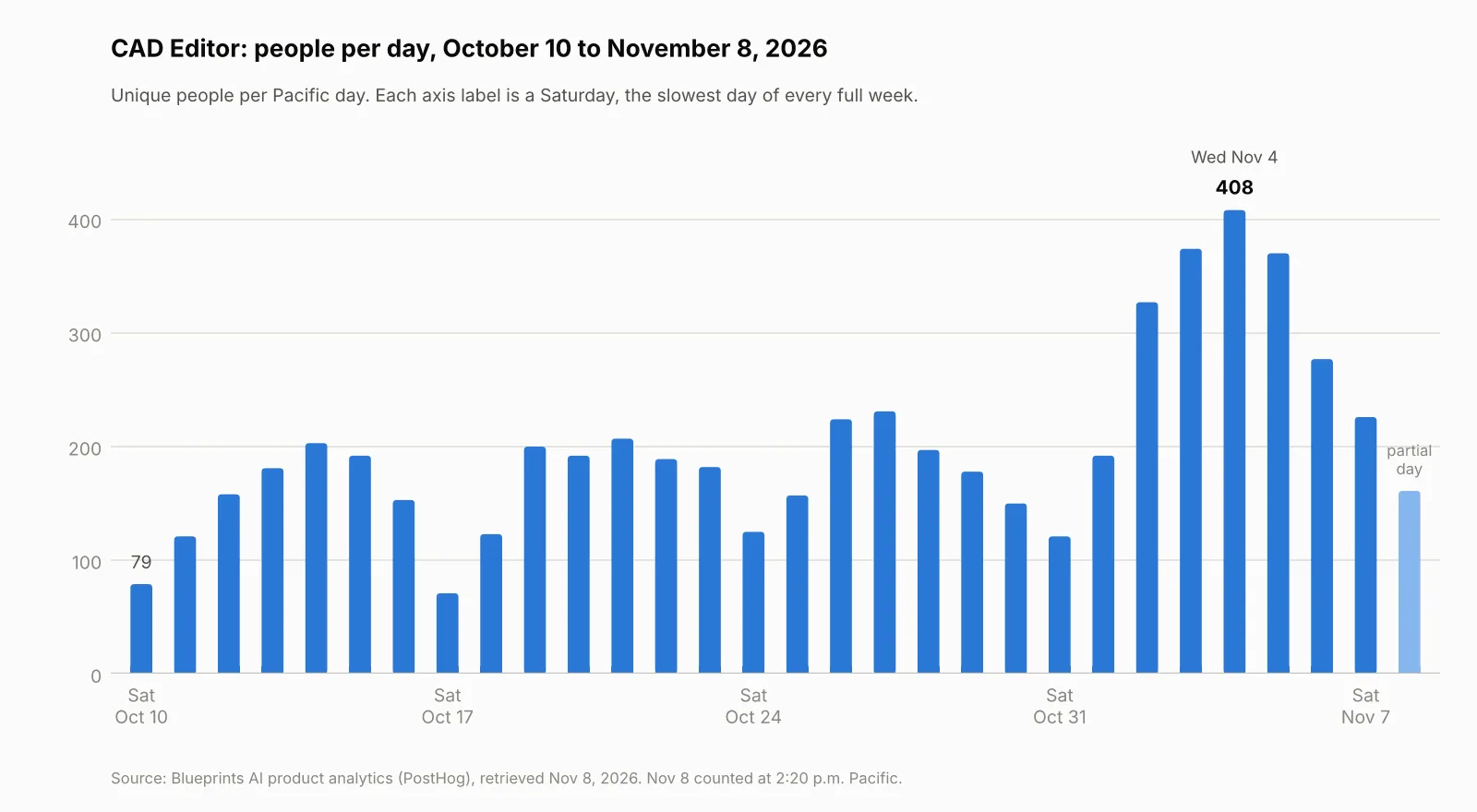
Here is what our analytics counted on November 8, 2026.[1]
| Measure | Count |
|---|---|
| People, past 30 days (Oct 10 to Nov 8) | 5,027, up from 2,418: 2.08× |
| People, October vs. September | 3,945 vs. 1,890: 2.09× |
| People since the first day (June 29) | 9,134 |
| Sessions since the first day | 13,379 |
| Time in the editor since the first day | 2,897 hours, about 1.4 work-years[18] |
| Average time per person | About 19 minutes since launch; 17 in the past 30 days |
| Countries | At least 100 |
| Top five | India 1,478 · United States 786 · Brazil 295 · Italy 281 · Germany 240 |
| Best day | Wednesday, November 4: 408 people |
The map matters to me more than the total. India leads the United States almost two to one. Somewhere on that map, I like to think, a four-year-old just rolled a ball for the first time. These days it is a trackpad.
Then there is Greece. One address in Greece, with five people behind it, has come back 46 times since mid-September and spent almost 69 hours in the editor. Its longest session ran just under seven hours.[1] Whoever you are: thank you.
One honest caveat: our analytics count a "person" as one browser until someone signs in, so one drafter on two devices counts twice, and anyone who blocks tracking is not counted at all.[19] We report the numbers as counted.
7. A Respectful Note to Autodesk (Receipts, Part Two)
I owe Autodesk twice: AutoCAD was my first software and 3D Studio MAX my second. If you work in buildings, there is a good chance your first was theirs too. So let me be fair and tell their story in numbers, because it is one of the great ones.
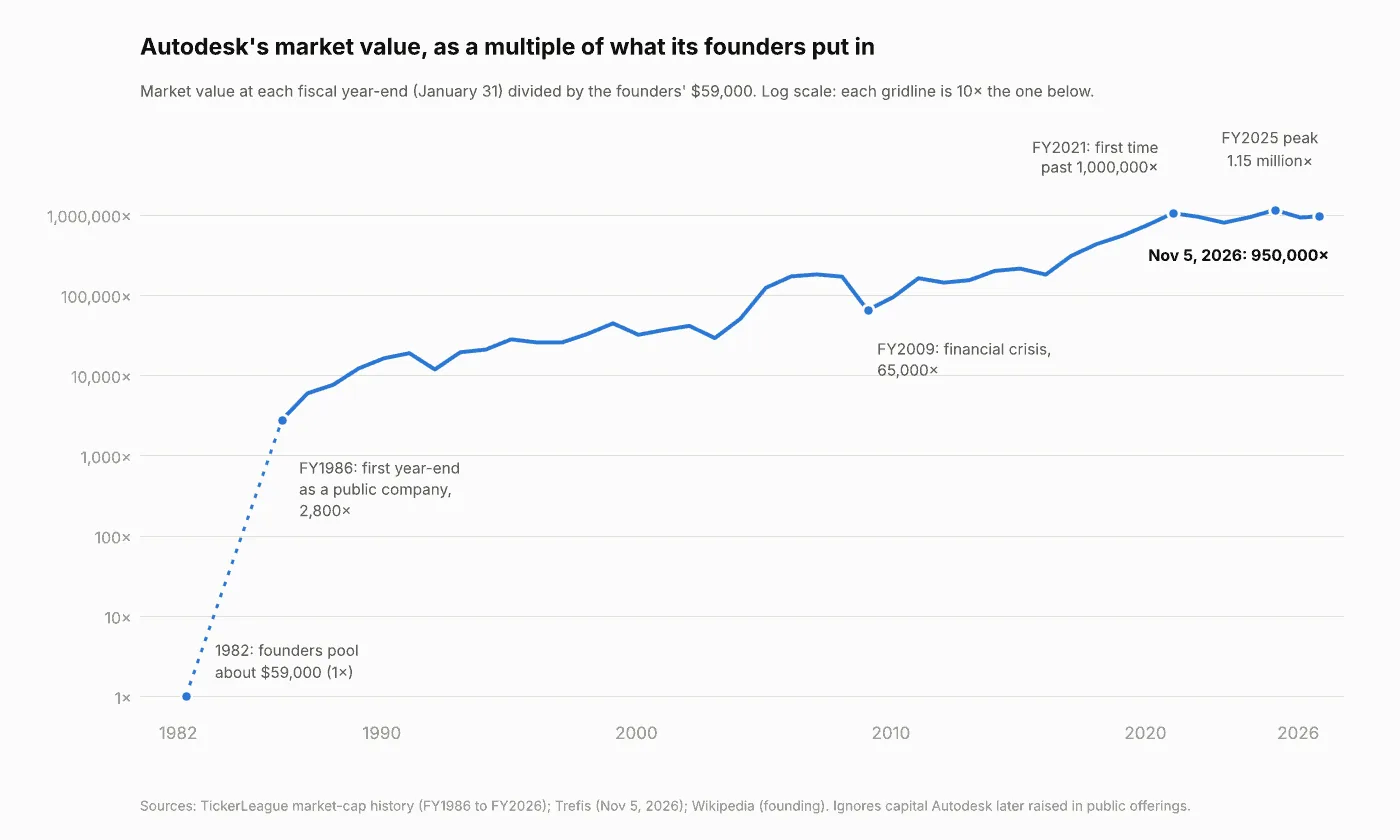
In 1982, John Walker and a small group of programmers pooled about $59,000 to start the company.[20] It went public in 1985.[21] Last fiscal year, Autodesk reported $7.2 billion in revenue, and $1.79 billion of it, about a quarter, came from AutoCAD and AutoCAD LT alone.[22] Over six fiscal years the AutoCAD family brought in about $8.6 billion (Table 2).[23] On November 5, 2026, the market valued the company at about $56 billion,[24] roughly 950,000 times what its founders put in (FIG. 11). In pocket-money terms, every $10 they put in now stands for about $9.5 million of company value. The same $10 in gold, bought in 1982, is worth about $108 today.[24] Gold did fine. It just was not software.
| Fiscal year | AutoCAD and AutoCAD LT | Change |
|---|---|---|
| FY2021 | $1,099M | |
| FY2022 | $1,244M | +13% |
| FY2023 | $1,387M | +11% |
| FY2024 | $1,462M | +5% |
| FY2025 | $1,572M | +8% |
| FY2026 | $1,787M | +14% |
| Six-year total | $8,551M |
Here is the thing about great tools. They win, become the standard, then the floor everyone stands on. The first CAD I touched lived on one laptop, behind one license, and a four-year-old got twenty minutes with it because a kind man decided he should. Today CAD opens in a browser tab, for free, for 5,000 people a month. The floor is now free.
Renting seats of a static tool fed a generation, me included. But what people need is the work done, by a person or, more and more, by an AI that follows a building from the first line to the permit stamp. That is the part we are building.
8. Conclusion: For Hamed
I got lucky. Lucky to grow up with four architects at the family table, lucky to be at that gathering, and lucky that a kind man with a laptop gave a four-year-old twenty minutes. I have been spending them ever since.
Hamed saw something in me nobody else could see. I hope he would see it in this: 5,027 people in a month, in at least 100 countries, drawing their first line or their ten-thousandth, in a browser, for free, with nobody calling them away to lunch.
Thank you, Autodesk, for R10 and for my first twenty minutes. Now, about lunch: we'll eat it byte by byte.
If you have never touched CAD, start here: cad-editor.com. No account, no install, no license. Roll the ball.
For Hamed Habibi, who gave a four-year-old twenty minutes and a trackball. Rest in peace.
References & Calculations
Sources consulted November 8 and 9, 2026. Market and usage figures carry their as-of dates and will drift; the arithmetic will not. Charts marked "drawn in code" were plotted from the cited data.
- ↩ §6 Blueprints AI, CAD Editor usage data. PostHog (the editor, cad.blueprints-ai.com) and Ahrefs Web Analytics (the site, cad-editor.com), retrieved November 8, 2026 and counted at 2:20 p.m. Pacific. Past 30 days (October 10 to November 8, Pacific days): 5,027 people, 7,143 sessions. Prior 30 days (September 10 to October 9): 2,418 people; 5,027 ÷ 2,418 = 2.08. October 2026: 3,945 people; September: 1,890; 3,945 ÷ 1,890 = 2.09. Since the first recorded day, June 29, 2026: 9,134 people, 13,379 sessions, 2,897 hours 19 minutes in the editor. Best day: November 4, 408 people. Countries are counted across every session since the first day; the report lists 100 of them, the smallest with 8 people, hence "at least 100." Greece: one returning address, 5 people, 46 sessions, 68 hours 54 minutes in total, longest session 6 hours 59 minutes, first seen September 17, last seen November 5. November 8 is a partial day. The daily counts in FIG. 10 come from the same report.
- ↩ §1 The triple wedding. Oral history, corroborated at every family gathering since. No published source exists, and nobody at those gatherings has ever asked for one. FIG. 2 was drawn in Python from the same oral history.
- ↩ §1 Computers in Iran, briefly. Arash Hackimi, Saeed Zafarany and Brandon Sheffield, "Iran video games timeline: from 1970 to 2019", Gamasutra (now Game Developer), March 2020. Their timeline has the Commodore 64, the Amiga 500, PCs and other machines arriving in Iran from January 1989, right after the Iran-Iraq war ended.
- ↩ §1 The ball, explained. Before touchpads, many laptops came with a trackball, built in or clipped to the side of the keyboard. Compaq's LTE Lite/25C, released June 15, 1992, is listed with the trackball included (Wikipedia, Compaq LTE), so the laptop was almost certainly newer than the 1988 software running on it. That was normal; people kept the release they had. On the color, the author's memory remains under review.
- ↩ §1 DOS, explained. See Wikipedia, MS-DOS. Windows 3.1 was released on April 6, 1992 (Wikipedia, Windows 3.1). AutoCAD Release 10 ran on DOS (Wikipedia, AutoCAD version history).
- ↩ §1 The classic AutoCAD screen. Commands sat in a screen menu, typically on the right side (Carlson Software, Command Entry); you typed into a command line below the drawing area (Triton College, the AutoCAD drawing screen); and the cursor was a crosshair, two intersecting lines (Autodesk, Beginner's Guide for CAD Terms). Release 10 predates the web, which is why we are citing its descendants.
- ↩ §1 The Micro. Micro Genius was a brand of Famicom clone consoles sold where Nintendo had no official presence, the Middle East among them, usually boxed with two wired controllers (Wikipedia, Micro Genius). It reached Iran in 1992 and was the first and most important of the clones there [3]. That our "Micro" was named after it is the author's inference, not a citation.
- ↩ §2 AutoCAD's debut: demonstrated at COMDEX in 1982 and released that December (Wikipedia, AutoCAD).
- ↩ §2 Release 10: shipped October 1988, with full 3D, multiple viewports and user coordinate systems, each dated to Release 10 in the feature history at the back of John Walker's The Autodesk File. See also its Release 10 chapter and Wikipedia, AutoCAD version history.
- ↩ §2 The Golden Hammer. Walker's 1988 award speech for the Release 10 team (The Autodesk File), which also notes perspective views and multiple windows on screen. 640K means 640 kilobytes, the memory a DOS program had to live in.
- ↩ §2 Floppies, explained. The 5.25-inch floppy disk held 360 KB in its double-density form and 1.2 MB in high density (Wikipedia, Floppy disk).
- ↩ §4 3D Studio MAX shipped in April 1996 for Windows NT. Like the DOS program 3D Studio before it, it was written by the Yost Group and published by Autodesk, this time through Kinetix, its newly renamed multimedia division; Autodesk bought the product at its second release and brought development in-house over the next two (Wikipedia, Autodesk 3ds Max; befores & afters, a visual history of 3ds Max). Release 1.1 followed the same year (Kinetix announcement, 1996). The author turned six that year; the rest of that story is in reference 43 of our Battlefield article.
- ↩ §4 YouTube launched in 2005 (Wikipedia, YouTube). 2005 - 1996 = 9.
- ↩ §5 Intent and timing, explained. This is our product thesis, not a published study. An editor inside the system can record each change, the order it happened in, and what triggered it. An exported file records only the final lines.
- ↩ §5 Seats, explained. A seat is one named user's license. Forty seats means forty people allowed to open the software.
- ↩ §5 Autodesk US list prices, autodesk.com/products, retrieved November 8, 2026: AutoCAD $2,095 a year, AutoCAD LT $540 a year, and the Architecture, Engineering & Construction Collection $3,675 a year, all marked as special offers that day. 40 × $540 = $21,600. 40 × $2,095 = $83,800. 40 × $3,675 = $147,000, and 3 × $147,000 = $441,000. Firms on enterprise agreements may pay different prices.
- ↩ §5 CAD Editor launch announcement, Blueprints AI Media Room, July 12, 2026: devices, drawing tools, file formats, and the 5 space 5 trick. Export options as shown in FIG. 9. In AutoCAD's default aliases, C starts CIRCLE and CO or CP starts COPY (Autodesk, Becoming More Efficient with Command Aliases); remapping C to COPY is common enough that Autodesk's own help uses it as the example (Autodesk Help, To Manage Command Aliases). CAD Editor makes C start Copy. Usage data begins June 29, 2026 [1]. For comparison: PhotoCraft, a free Photoshop alternative built largely with AI coding tools, comes from Brandon Thomas's ArtCraft project (Ubergizmo, October 2026), and free open-source copies of Photoshop, Premiere and Lightroom were being reported by October 9, 2026 (ProPakistani). CADCraft, its AutoCAD-style sibling, shows a first skeleton commit dated October 5, 2026 (CADCraft repository mirror Removed by the publisher; official repository at github.com/storytold/cadcraft).
- ↩ §6 Calculations. 2,897.3 hours ÷ 2,080 hours (40 hours × 52 weeks) = 1.39 work-years. Average time per person since launch: 10,430,346 seconds ÷ 9,134 people = 1,142 seconds, about 19 minutes. For the past 30 days alone: 5,195,044 seconds ÷ 5,027 people = 1,033 seconds, about 17 minutes.
- ↩ §6 Method. A "person" is PostHog's person: one browser until someone signs in, one account after. A session is one visit, and a new one starts after 30 minutes away. Time in the editor is each session from its first event to its last, so a one-page visit counts as zero. Visitors who block tracking are not counted.
- ↩ §7 Autodesk's founding. Wikipedia's entry on John Walker has him and 12 other programmers pooling $59,000 in 1982, and Shapr3D's History of CAD gives the same figure. Wikipedia's Autodesk entry counts 16 founders and $60,000. We use $59,000.
- ↩ §7 Public company: Autodesk went public in 1985 (Wikipedia, Autodesk).
- ↩ §7 Autodesk fiscal 2026 results, February 26, 2026 (Form 8-K, SEC): total net revenue $7,206M; AutoCAD and AutoCAD LT $1,787M, up 14%. 1,787 ÷ 7,206 = 24.8%.
- ↩ §7 AutoCAD and AutoCAD LT revenue by year: FY2021 $1,099M and FY2022 $1,244M (Form 10-K for fiscal 2023, SEC); FY2023 $1,387M (fiscal 2023 results); FY2024 $1,462M and FY2025 $1,572M (fiscal 2025 results); FY2026 $1,787M [22]. Sum: $8,551M. Autodesk has moved some revenue between product families over the years, so changes that span two reports are approximate.
- ↩ §7 Market value, and the gold comparison: share price $269.0 and market cap $56.2B on November 5, 2026 (Trefis, Autodesk). $56.2B ÷ $59,000 ≈ 952,000, so each $10 of founding money stands for about $9.5 million of market value. That is value per founding dollar, not an investor's return: Autodesk issued more shares after 1982, including at its 1985 IPO, which would have diluted any early stake. Gold averaged $376 per troy ounce in 1982 (metalcharts.org, LBMA annual average) and closed at $4,044.65 on November 5, 2026 (pricegold.net). $10 ÷ $376 × $4,044.65 = $107.57. Neither figure is adjusted for inflation.
- ↩ §7 FIG. 11, how it was drawn. Market value at each fiscal year-end from 1986 to 2026, as listed by TickerLeague, Autodesk market cap history Removed by the publisher, plus the November 5, 2026 value [24], each divided by $59,000 [20]. Fiscal 1986: $164.71M ÷ $59,000 = 2,792. Fiscal 2009: $3.81B ÷ $59,000 = 64,576. Fiscal 2021: $61.62B ÷ $59,000 = 1,044,407, the first year past a million. Fiscal 2025, the peak: $67.56B ÷ $59,000 = 1,145,085. November 5, 2026: $56.2B ÷ $59,000 = 952,542. Plotted in Python on a log scale. The multiple ignores money Autodesk raised after its founding, including at its 1985 IPO, so it overstates any one investor's return.